
Tag: automation

  • Proximity Sensor Circuit Technology

    Proximity Sensor Circuit Technology

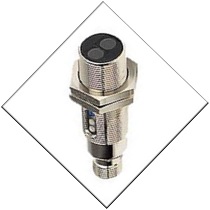
    Discrete output proximity sensors are most important for industrial applications. They gain importance in such applications where it is necessary to record or count moving objects or work-pieces on machines or conveyors. Based on the way of connection of the final output amplifier transistor of a discrete proximity sensor to the power supply terminals, proximity sensors can be categorized into two types:

    • Sinking (NPN) output sensors
    • Sourcing (PNP) output sensors

    Sourcing (PNP) Output sensor

    The sourcing output sensor has a PNP transistor output with its emitter connected to the +Vcc of the supply for positive switching, as shown in Figure 1. The load is connected between the proximity sensor output and the negative potential. This connection means that the sensor output will be pulled up to the positive potential, and hence the grounded load will be connected to the positive potential through the transistor in the switched state. This connection will allow the current to flow from the positive potential through the sensor to the output (hence sourcing). This sensor is best selected when all electrical devices in the control system use a single source of the supply voltage.

    Figure 1 | A sourcing output proximity sensor and its load connection

    Discrete Sensor connection to PLC Input

    As discussed, the output of a discrete proximity sensor can be sinking or sourcing type. Similarly, a discrete PLC input can be sinking or sourcing type. Remember, it is important to interface a proximity sensor to the associated PLC input correctly for the proper operation of the PLC system. In general, a sourcing proximity sensor should be connected to a sinking PLC input, and a sinking proximity sensor should be connected to a sourcing PLC input to avoid the erratic operation of the system. For the sourcing sensor output, the PLC input circuit is wired with the common terminal connected to the common of the sensor, as shown in Figure 2.

    Figure 2 | A sourcing sensor output connected to a sinking PLC input


    Electro-pneumatics and Automation

    Joji Parambath

    This book explains the functioning of primary solenoid valves and various electrical control components. Many typical single-actuator and multiple-actuator electro-pneumatic circuits are also developed to illustrate various applications of electro-pneumatics.


    Joji Parambath

    Author

    Fluid Power Educational Series Books

  • Electro-pneumatic Circuit Development for a stamping device


    Electro-pneumatics and Automation

    Authored by Joji Parambath

    This book explains the functioning of single and double solenoid valves and various electrical control components such as pushbuttons, electro-magnetic releys, limit switches, reed switches, proximity sensors, timers, preset counters, and pressure switches. Many typical single-actuator and complex multiple-actuator electro-pneumatic circuits are also developed to illustrate various applications of electro-pneumatics.


    Control Task: Cylinder A extends and brings a job under the stamping cylinder B. Cylinder B then extends and stamps the job. Cylinder A can return only after cylinder B has retracted fully. An electro-pneumatic control circuit has to be developed for realizing the control task.

    Control task in Notational Form

    Figure (a) | Notational form of representation of the pneumatically-controlled stamping device

    [Note: The electro-pneumatic circuits below are extracted from the textbook on ‘Electro-pneumatics and Automation’ authored by Joji Parambath. For the explanation of solution in cascade method for this control task and more complicated electro-pneumatic circuits, please refer to the textbook.]


    Circuit position for A+


    Circuit position for B+


    Circuit Position for B-


    Circuit Position for A-


    Joji Parambath

    Trainer / Author

    Fluidsys Training Centre Pvt Ltd

    Bangalore, India

    https://fluidsys.org

    For details of more books from the same author, please visit: https://jojibooks.com

  • The Concept of Automation

    The Concept of Automation

    The process of carrying out an industrial task usually involves many recurring steps. These steps can be carried out manually or automatically. In the manual system, an operator is always present to decide every process step. In the automatic system, the process controls itself, partially or entirely, by the feedback of its condition. Therefore, an automatic system can be semi-automatic or fully automatic. 

    In semi-automation, a machine automatically carries out several recurring partial steps in processing a workpiece. Here, an operator is required to initiate every cycle of operations.

    In complete automation, a machine automatically performs cyclic operations to process several jobs. Sensors and/or transducers are invariably used in automatic control systems.

    Joji Parambath

    Director

    Fluidsys Training Centre Pvt Ltd

    Bangalore, India

    https://fluidsys.in

    Amazon Author URL:

    https://www.amazon.com/author/joji