Tag: pressure relief valve

  • A Comparative Study of Pressure Control Valves

    A Comparative Study of Pressure Control Valves

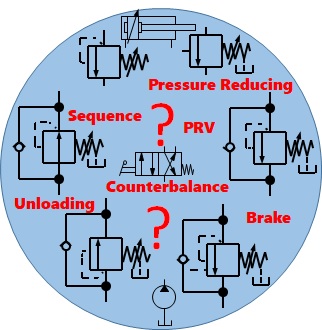
    Pressure control valves are used in hydraulic systems for obtaining pressure-related regulation and control tasks. The control tasks include limiting the maximum operating pressure in a hydraulic system, reducing the pressure in a part of a hydraulic circuit, unloading pumps, establishing the sequence movements of actuators, counterbalancing overrunning loads, and braking hydraulic motors while running on inertia. Accordingly, PRVs manifest themselves in a variety of forms.

    Types of Pressure Control Valves

    According to their function in hydraulic circuits, pressure regulating and control valves can be categorized into many basic types. They are (1) pressure relief valves, (2) pressure reducing valves, (3) unloading valves, (4) sequence valves, (5) counterbalance valves, and (6) brake valves. The symbolic representations of these valves are given in Figure 1.

    Figure 1: Symbols of pressure control valves

    Comparison of Pressure Control Valves

    A basic comparison of some of the pressure control valves is highlighted below, in a most generalized way.

    Figure 2: A comparison table for pressure control valves

    By

    Joji Parambath

    Author / Trainer

    joji.p@hotmail.com


    Note:

    A detailed explanation of pressure control valves and their circuits in multiple positions is given in the books ‘(1) Industrial Hydraulic Systems and Circuits -Basic Level (In the SI Units), (2) Industrial Hydraulics -Basic Level (In the English Units),’ (in Paperback/hardcover/Kindle eBook versions) authored by Joji Parambath and published through the Kindle Direct Publishing.


    Many books (37 Nos) on Pneumatics and Hydraulics in paperbacks, hardcover, and Kindle eBook formats authored by Joji Parambath are published through the Kindle Direct Publishing platform for systematic and quick understanding of the subject of Pneumatics and Hydraulics. 

    All books are available at Amazon marketplaces and other dealers.


    Are you looking for a course on Pneumatics and Hydraulics?

    Please visit Fluidsys Training Centre Pvt. Ltd., Bangalore, India. https://fluidsys.in

  • The Essential Parameters of Pressure Relief Valves


    Some essential factors concerned with the operation of hydraulic pressure regulators are its set pressure, cracking pressure, full-flow pressure, pressure-override, closing pressure, overpressure, blowdown, and backpressure. These useful terms are defined in the following sections:

    Set Pressure

    A PRV is set to open at the inlet pressure under the specified service conditions.

    Cracking (Opening) Pressure

    It is the value of increasing the inlet pressure of a PRV at which there is a measurable lift of its poppet and continuous discharge of the fluid through it.


    Textbook on ‘Hydraulic Power Packs in the SI Units

    By Joji Parambath

    The book deals with power pack components such as hydraulic reservoirs, pumps, pressure relief valves, unloading valves, filters, accumulators, and power pack control units. It also presents the noise reduction techniques for hydraulic systems. Next, the book highlights power packs with standardised assemblies. The book uses the SI system of units.


    Textbook on ‘Power Packs in Hydraulic Systems in the English Units

    By Joji Parambath

    Please click on the images to go to the Amazon Website


    Full-flow Pressure

    The pressure at the inlet of a PRV, when it is passing its rated maximum flow, is called the full-flow pressure.

    Pressure Override

    The difference between a PRV’s full-flow pressure and cracking pressure is called the pressure override or the pressure build-up over the PRV’s set point.

    Closing Pressure

    It is also known as ‘reseat’ pressure. The closing pressure of a PRV is the value of decreasing inlet pressure at which the poppet of the PRV re-establishes firm contact with the seat.

    Overpressure

    It is the pressure increase above a PRV’s set pressure, expressed in pressure units or as a percentage.

    Backpressure

    It is the pressure that exists at the outlet of a PRV as a result of the pressure in the discharge system. It may be subdivided into superimposed and built-up backpressures.

    Superimposed Backpressure

    This is the backpressure acting on the outlet of a closed PRV. It is the effect of the pressure in the discharge system coming from multiple sources.

    Built-Up Backpressure

    It is the increase in the pressure in the PRV’s discharge header when fluid flows through it.

    Joji Parambath

    Author / Trainer

    Fluid Power Educational Series Books

    https://jojibooks.com


    Please contact Fluidsys Training Centre Pvt. Ltd., Bangalore, India for your training needs
