Tag: compressed air

  • Filtration Principles of Pneumatic and Hydraulic Systems: A Comparison Study

    Filtration Principles of Pneumatic and Hydraulic Systems: A Comparison Study


    This article is the third part of the following three-part series of articles:

    Filtration and Drying Principles in Pneumatic Systems

    Filtration Principles in Hydraulic Systems

    Filtration Principles of Pneumatic and Hydraulic Systems: A Comparison Study


    The filtration principles of pneumatic and hydraulic systems were given in the previous articles. The third part of the three-part series of articles on filtration principles in fluid power systems attempts to make a comparison of the filtration principles, as given in Table 1. A comparative study of the filtration principles would bring out the essential similarities as well as differences in the filtration principles and would provide an overall view of the subject matter.

    Table 1 | A comparison of the filtration principles in pneumatic and hydraulic systems

    ParameterPneumaticsHydraulics
    Medium of energy transferCompressed airOil
    ContaminantsParticles, moisture, oil, +Particles, chemical contaminants, moisture, air, +
    Effect of contaminantsAbrade surfaces
    Corrode internal parts
    Reduce functionality and service life of components
    Abrade surfaces
    Corrode internal parts
    Reduce service life of oil
    Cleanliness standardsISO8573ISO 11171 & ISO4406
    NAS1638
    SAE AS4059
    Particle removalFiltersFilters, Magnets
    Moisture removalDryers, FiltersVacuum dehydrator
    Oil (air) removalCoalescing filters
    Adsorption filters
    Air bleeds
    Diffuser (Baffle screen)
    Filter typesGeneral purpose filters
    Coalescing filters
    Adsorption filters
    Surface filters/ Depth filters
    Cartridge type/ spin-on
    Inline filters
    In-tank filters
    Filter mediaSintered bronze/ polyethylene
    Borosilicate glass microfibres
    Activated carbon
    Wire mesh
    Paper
    Synthetic
    Filter locationsIntake
    Mainline
    Service line
    Suction side
    Pressure side
    Return-line
    Offline

    Joji Parambath

    Author, Fluid Power Educational Series Books

    Pneumatic and Hydraulic Books authored by Joji Parambath

    37 books in Paperback and Kindle eBook versions on the subjects of Pneumatics and Hydraulics, authored by Joji Parambath, have been published under Fluid Power Educational Series. Joji Parambath is a trainer in the field of Pneumatics, Hydraulics, and PLC, for over 25 years. All the books are available at Amazon marketplaces.

    These books deal with pneumatic system components and circuits. The fundamentals required to understand the core topics are given initially. These books describe the topics on compressed air generation and contamination control, pneumatic actuators, and control valves, in detail. Further, these books present the maintenance, troubleshooting, and safety aspects of pneumatic systems. Many single-actuator pneumatic circuits are given in multiple positions. Many critical positions of pneumatic single-actuator circuits are given to make the reader understand the control circuits easily.

    These textbooks deal with the components and circuits of hydraulic systems. The fundamentals required to understand the core topics are given initially. The book describes the topics on hydraulic fluids, filters, power packs (reservoirs, pumps, pressure relief valves) hydraulic actuators, directional control valves, flow control valves, pressure control valves, fluid conductors, and accumulators, in detail. Further, the book presents the maintenance, troubleshooting, and safety aspects of hydraulic systems.

    These books explain the basic principles of hydrostatic transmissions. The concepts of open-circuit and closed-circuit HSTs are explained in the book. The topics also include configurations, advantages and disadvantages, and applications of HSTs.

    These books enlighten the details of components required for load sensing systems. The operation of load sensing systems in their various operating modes is described in a simplified manner.

    The book ‘Electro-hydraulic proportional valves’ explores the technology used in proportional valves. The book also describes the construction of electro-hydraulic proportional valve systems, the details of various types of control elements, characteristics, and applications of proportional valve systems.

    The book ‘Electro-hydraulic servo valves’ describes the technology used in state-of-the-art servo valves. The book also describes the construction of electro-hydraulic servo valve systems, the details of various types of control elements, and the applications and characteristics of servo valve systems.

    These books explain the functioning of solenoid valves and various electrical control components such as pushbuttons, electro-magnetic relays, limit switches, reed switches, proximity sensors, electronic timers, and counters. The development of many typical single-actuator and multiple-actuator electro-pneumatic and electro-hydraulic circuits are also separately explained in these books. Many circuits are given in multiple positions for a quick understanding of the working of each circuit.

    And many more ….
  • Filtration and Drying Principles in Pneumatic Systems

    Filtration and Drying Principles in Pneumatic Systems


    This article is the first part of the following three-part series of articles on filtration:

    1. Filtration and Drying Principles in Pneumatic Systems

    2. Filtration Principles in Hydraulic Systems

    3. Filtration Principles of Pneumatic and Hydraulic Systems: A Comparison Study


    A pneumatic power system transmits the power in a controlled manner using a compressed air medium. Remember, the medium links all the components in the system. Compressed air can be used in a range of applications/industry segments, including machine and plant construction, metal production, textile, rubber, plastic, and chemical industries, pharmaceutical companies, food production, dairies, foundries, etc.

    Contamination

    However, the compressed air medium is susceptible to various types of contaminants, like solid particles, moisture, oil particles, etc. The solid particles can be very fine or coarse. The moisture can be in the vapour form or liquid form and the oil particles can be in a fine liquid form (aerosol) or vapour form (hydrocarbons). These contaminants can enter the system through the intake air or generate internally due to abrasion, corrosion, etc.

    Effect of Contamination

    Contaminants are harmful to the components of a pneumatic system. They tend to reduce the functionality and service life of components. The removal of contaminants from a compressed air medium can prevent costly breakdowns and production downtime. It can also keep maintenance and repair costs to a minimum. Therefore, the fluid medium must be kept in a clean state to protect the components and system.

    Critical Issues in Compressed Air Medium

    The following three concerns must be addressed to maintain the system compressed air medium in a perfect working condition:

    (1) What are the harmful contaminants present in the system?

    (2) How to remove these contaminants?

    (3) How much of the contaminants must be removed for the satisfactory operation of the system?

    Also, there exists an international standard ISO 8573:2010 to specify contaminants and define quality classes of compressed air. The end-users, manufacturers, or any other stakeholders can take advantage of the standard.

    ISO 8573: Contaminants and Purity Classes of Compressed Air

    The standard ISO 8573 consists of nine separate parts, with part 1 specifying the types of contaminants and quality requirements of the compressed air.

    The standard ISO 8573-1 specifies the three types of contaminants for a compressed air system. They are: solid contaminants, water, and oil particles. This part of the standard also specifies purity classes of compressed air with respect to particles, moisture, and oil.

    For each of the three types of contaminants specified in part 1, the standard defines purity classes based on the maximum amount of the related contaminant. The higher the class, the lower the degree of the compressed air purity.

    Parts 2 to 9 of the standard specifies the methods of testing for a range of contaminants, including solid particles, moisture, oil aerosols, microbiological contaminants, and gaseous contaminants (CO, CO2, SO2, hydrocarbons, etc).

    Different industry segments and applications require different levels of purity for processes to run smoothly. A suitable level of compressed air purity improves the service life and efficiency of a system. The standard assists end-users in specifying the air quality requirements and makes the selection of air preparation equipment easy. The levels of compressed air purity, which can be achieved using filters and dryers, are usually specified by component manufacturers.

    Contaminant Removal Techniques

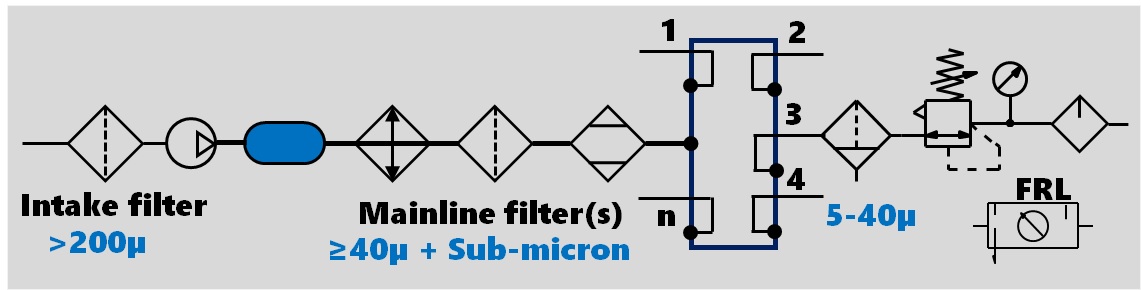
    The solid particles and oil particles can be removed by a combination of general-purpose filters, coalescing filters, and adsorbent filters. Bulk liquid water can also be removed by filters. Moisture in the vapour form can only be removed by using air dryers.

    Filters

    Filters are used in a pneumatic system to filter out particles, condensate, and oil, and achieve specific purity classes. They are located at the intake of the compressor and in the mainline and service line of the pneumatic system. A pneumatic filter is usually provided with a drain facility and a clogging indicator. The classification of pneumatic filters is given below.

    • General-purpose filters typically have a pore size of 5 to 40 µm and can achieve only a lower level of purity. The typical filter materials for general-purpose filters are made of sintered bronze [40µ (standard), 20µ, 5µ] and polyethylene (5µ, standard).
    • Sub-micron coalescing filters can filter out particles smaller than 1 µm to achieve a higher level of purity. The filter media in coalescing filters are made of borosilicate glass microfibres.
    • An adsorbent filter removes oil vapour from compressed air that cannot be removed by coalescing filters. The filter cartridge in an adsorbent filter contains activated carbon to adsorb hydrocarbon vapours.

    Dryers

    Dryers are critical components of pneumatic systems for drying compressed air. The most common methods of compressed air drying are: (1) the adsorption method and (2) the refrigeration method. It may be noted that the lower the pressure dew point, the higher will be the capacity of a dryer to remove moisture.

    • Adsorption dryers can deliver pressure dew points of -40°C [-40°F] at 7 bar [100 psig] typically. However, note that adsorption dryers can also deliver pressure dew points down to -70°C [-94°F].
    • Refrigeration dryers can produce dew points in a range from 1.7°C to 10°C (35°F to 50°F) at the system operating pressure.

    Joji Parambath

    Author, Fluid Power Educational Series

    Pneumatic Books authored by Joji Parambath

    Books available at Amazon market places

    These books deal with pneumatic system components and circuits. The fundamentals required to understand the core topics are given initially. These books describe the topics on compressed air generation and contamination control, pneumatic actuators, and control valves, in detail. Further, these books present the maintenance, troubleshooting, and safety aspects of pneumatic systems. Many single-actuator pneumatic circuits are given in multiple positions. Many critical positions of pneumatic single-actuator circuits are given to make the reader understand the control circuits easily.

    This book entitled ‘Pneumatic Systems and Circuits -Advanced Levelexplains the method of developing pure pneumatic advanced circuits involving multiple actuators. The problem of signal conflicts and various methods of eliminating signal conflicts are explained in detail in this book. The developments of multiple-actuator circuits using the cascade method and shift register are explained through many examples. Intermediate positions of circuits are also given wherever possible to ensure an easy understanding.

    This book explains the functioning of solenoid valves and various electrical control components such as pushbuttons, electro-magnetic relays, limit switches, reed switches, proximity sensors, electronic timers, and counters. The development of many typical single-actuator and multiple-actuator electro-pneumatic and electro-hydraulic circuits are also separately explained in these books. Many circuits are given in multiple positions for a quick understanding of the working of each circuit.

    These books describe the design aspects of pneumatic systems in the SI system units and the English system units for educational purpose. These books highlight the essential parameters, mathematical relations, and specifications of many pneumatic components such as compressors, air preparation units, actuators, control valves, and compressed air networks. Examples of designing typical industrial pneumatic systems are also given in this book. The knowledge gained may be applied to develop more extensive industrial pneumatic systems. 

    This books explains all aspects of maintenance, troubleshooting, and safety in pneumatic systems, systematically to make this book useful on the shop floor. A section on energy saving highlights the steps that need to be taken for saving a substantial amount on energy costs in pneumatic systems.

    Other Books