Several essential mathematical relations are also given in books ‘(1) Industrial Hydraulic Systems and Circuits -Basic Level (In the SI Units), (2) Industrial Hydraulics -Basic Level (In the English Units), (3) Design of Industrial Hydraulic Systems (In the SI Units), and (4) Design Concepts in Industrial Hydraulic Systems (In the English Units)’ authored by Joji Parambath and published through the Kindle Direct Publishing. These books are available in paperback, hardcover, and Kindle eBook versions.
Further, many books (37 Nos) on Pneumatics and Hydraulics in paperbacks, hardcover, and Kindle eBook formats authored by Joji Parambath are published through the Kindle Direct Publishing platform for systematic and quick understanding of the subject of Pneumatics and Hydraulics.
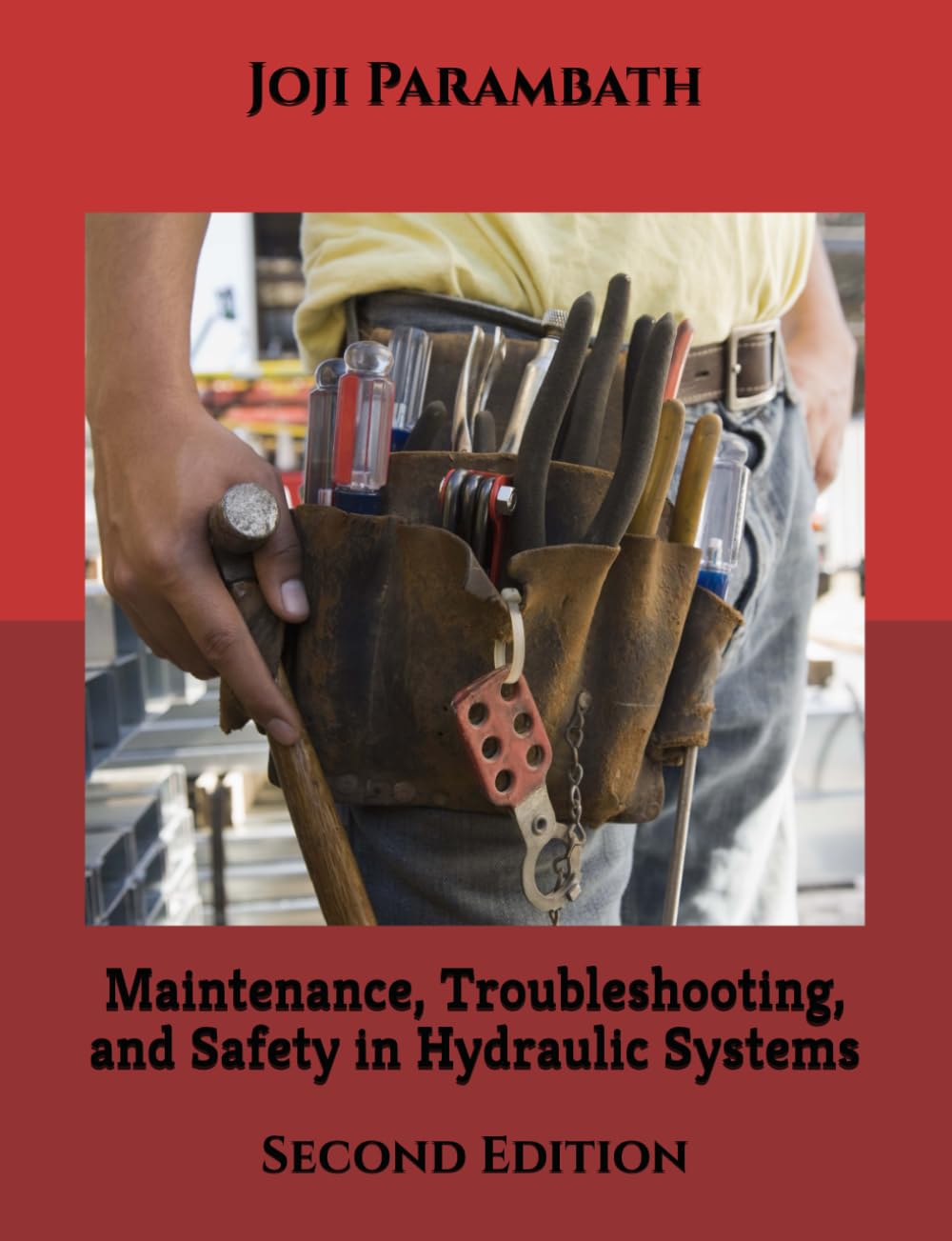
These books deal with the components and circuits of hydraulic systems. The fundamentals required to understand the core topics are given initially. These books describe the topics on hydraulic fluids, filters, power packs (reservoirs, pumps, pressure relief valves) hydraulic actuators, directional control valves, flow control valves, pressure control valves, fluid conductors, and accumulators, in detail. Further, these books present the maintenance, troubleshooting, and safety aspects of hydraulic systems.
These books separately describe the design aspects of hydraulic systems in the SI system units and the English system units for educational purposes. These books highlight the essential parameters, mathematical relations, and specifications of many hydraulic components such as hydraulic pumps, reservoirs, pressure relief valves, filters, fluids, hydraulic cylinders, hydraulic motors, control valves, accumulators, and fluid conductors. Examples of designing typical industrial hydraulic systems are also given in these books.
Are you looking for a course on Pneumatics and Hydraulics?
Please visit Fluidsys Training Centre Pvt. Ltd., Bangalore, India. https://fluidsys.in
Hydraulic cylinders are used in many types of machines and systems for industrial and mobile applications. The manufacturing process of cylinders mainly involves the following steps: design, heat treatment, machining, coating, assembly, and testing.
The Design Phase, Cylinder Manufacturing
In the design stage, the requirement specifications of the cylinder to be designed are transformed into technical drawings describing the materials of construction, dimensions, tolerances, quality of internal surfaces, and coating methods.
Requirements of Barrels
The barrel should have sufficient strength and enough rigidity. The barrel should also have smooth interior surfaces, high precision tolerances, and durable service life. The requirement specifications for a barrel in a hydraulic cylinder can be realized by a proper selection of barrel material.
Materials for Barrels
There are many steel materials available in terms of their tensile strengths. A barrel for a hydraulic cylinder can generally be prepared from an annealed cold-drawn or hot-rolled seamless steel tube. The steel type is usually carbon steel. However, in applications with corrosive environments, stainless steel can be used.
Machining Process (Boring) for Barrels
Machining is a metal removal process that depends on boring, cutting and grinding operations to remove unwanted material from the barrel to achieve a final shape. The boring operation is the main process of machining the barrel for achieving dimensional and surface finish tolerances.
Precision Machining of Barrels
After cold drawing and heat treatment, the partly finished barrel is additionally prepared for improving the surface finish and the geometric form of the inner surface of the barrel using the following methods: (1) Honing process and (2) SRB (Skiving & Roller Burnishing) process.
Preparing Pistons
The piston is first machined for correct sizing. It must then be quenched and tempered for hardness. Verify its hardness through a hardness test. The correctly-sized piston is, then, machined with grooves to fit seals and bearing elements. The piston is inseparably attached to the piston rod using threads, bolts, or nuts.
Preparing Piston-rods
The piston rod must be machined for obtaining the correct shape and size. First, it must be roughly machined. It must then be quenched and tempered for hardness. Verify its hardness. It must then be heat treated through induction hardening, carburizing, or nitriding method to improve its surface hardness. It must then be precision machined, finely ground, and polished to provide a reliable seal and prevent leakage.
The piston rod is then coated with hard chrome plating or subjected to surface heat treatment. It must then be polished to provide a reliable seal and prevent leakage.
Preparing Cylinder End Plates
The manufacturing process of a cylinder head with rod sealing, guiding, cushion, and porting arrangements, involves the inspection of the material certificate, rough machining, quenching and tempering, hardness testing, precision machining, internal and external threading, sawing, milling, boring and fitting, and final inspection.
Cylinder Ports
On hydraulic cylinders, standard ports are SAE O-ring threaded ports. Another porting option is a four-bolt flange port. Yet other port options are NPTF dry seal threads and BSPP threads.
Coating, Painting, and Polishing
The outside surface of the barrel must be spray painted as per the relevant standards. Hard chrome coating is provided on the piston. The surfaces of piston-rod are often treated using techniques such as Nickel-Chromium plating, laser cladding, supersonic flame spraying, or thermal spraying for making it wear-resistant and corrosion-resistant.
Seals for Cylinders
The selection of the right seal profile and material for a given application requires consideration of many factors such as the piston-rod and bore diameters, seal groove dimensions and gaps, etc.
Assembly of Cylinder Parts
The fitting section assembles all the components of a cylinder, such as a piston rod, piston, tube and seals, with the necessary tools and utmost care.
Quality Control of Cylinders
A strict quality control procedure should be in place in every step of the production process to meet the specifications.
Tests and Inspections
The manufactured cylinder must undergo performance testing under load to confirm its specifications as per the requirement specifications. Ensure that all dimensions and technical requirements of the cylinder are as per the drawing. Arrange inspection by third-party agencies if required.
By
Joji Parambath
Trainer / Author
More details on hydraulic cylinders can be accessed from the following books authored by Joji Parambath.
Are you looking for a course on Pneumatics and Hydraulics?
Please visit Fluidsys Training Centre Pvt. Ltd., Bangalore, India. https://fluidsys.in
Most of the hydraulic system failures are similar. That is there is a sudden or gradual loss of pressure or flow. Consequently, cylinders and motors in these systems may stop working. Any of the system components can be at fault. Possible causes of hydraulic cylinder faults and their rectification are highlighted below:
Possible causes
Rectification
General
Damaged/worn seals
-Replace seals
Excessive rod wear
-Prevent wear
Rod damaged
-Replace rod
Rod seized
-Repair
Faulty alignment
-Align properly
Broken linkages
-Replace damaged linkages
Loose mountings
-Tighten mounting bolts
Jerky movement
-Assemble piston packing correctly -Avoid heavy load at slow speed
-Bleed cylinder of entrained air -Check and set cylinder cushion
Erratic operation
Air in system
-Clean filters -Replace worn seals -Drain and flush fluid -Change system fluid -Fill reservoir to proper level -Tighten leaking connections -Bleed air from system -Replace worn shaft/seal
– Repair or replace worn parts –Tighten loose packing -Use medium viscosity fluid -Control fluid contamination -Control wear
References:
Categories of malfunctions in hydraulic systems in terms of its general disturbances, and their possible causes and rectification are presented in the above books. Further, the component-wise malfunctions and their potential causes and rectification are also presented.
Joji Parambath
Director
Fluidsys Training Centre
Are you looking for a course on Pneumatics and Hydraulics?
Please visit Fluidsys Training Centre Pvt. Ltd., Bangalore, India. https://fluidsys.in